
Although the weather has been extreme in 2026, it takes the institutions that govern us a long time to decide what to do to tackle climate change.
We gardeners and environmentalists need to be involved with the changes now occurring and which will affect all of us. There are predications that it will be even hotter in 2027, so change will be here very soon.
Any local groups who would like to gather local information about climate change in their area and ideas about how best to protect our urban environment, are welcome to Contact Us and share their views.
If you value having someone campaign on your behalf to protect the environment and having access to useful articles about gardening and local environmental matters, please make a donation to help us with the cost of maintaining The East London Garden Society.
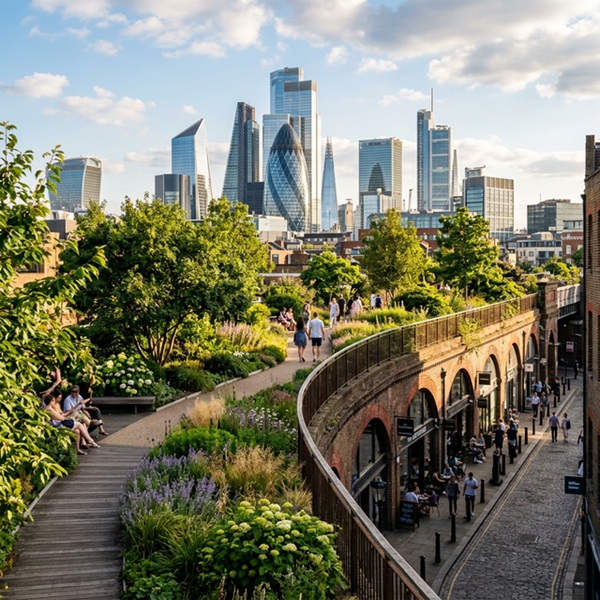
It has been several years since we first heard that a new park would be created by the developers of the Bishopsgate Goods Yard. It was The East London Garden Society's initiative to have a new park on top of the redundant rail lines and to make it the largest forest garden in Europe. The forest is enshrined within the planning application at the Greater London Authority.
Although the forest will be one of the last aspects of the development to be created, we have been told that works will begin in October 2026 at which time the design will be published. It is our hope that this will include a forest, so maximum pressure must be put on those concerned to make what was once just a fancy into reality.
The Greek physician Dioscorides first documented mullein in the 1st century AD as a remedy for lung conditions and coughs. Romans called the plant Jupiter’s Staff and dipped its dried tall stalks in fat to use as funeral or ceremonial torches. Aristotle and later European fishermen used crushed mullein seeds in streams and ponds as a natural fish poison, a practice later outlawed in Europe during the 13th century.
In European folklore, mullein was considered an apotropaic plant, meaning it could banish evil spirits, protect the home, and bring courage. Due to its soft, woolly leaves, it gained over 40 common English names by the 19th century, including grandmother's flannel, candlewick plant (where dried leaves or stems served as lamp wicks), and poor man's blanket. The word mullein itself comes from an old French word for soft.
In the realm of herbal remedies, few plants boast the versatility and historical significance of the Great Mullein (Verbascum thapsus). This unassuming biennial herb, also known as Common Mullein or Velvet Plant, has a rich history of medicinal and practical uses that span centuries and cultures. From its striking appearance to its numerous health benefits, Great Mullein remains a cherished botanical wonder.
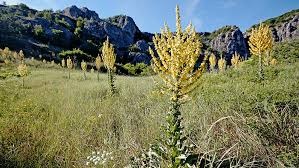
One of the first things that capture your attention when encountering Great Mullein is its striking appearance. This herb grows as a tall, upright stem, often reaching heights of six feet or more. Its leaves are soft and velvety, lending the plant its characteristic texture.
In its second year, Great Mullein produces a towering spike adorned with bright yellow, five-petaled flowers, creating a mesmerising sight in fields and along roadsides. Its vibrant presence in the wild has made it a favourite among herbal enthusiasts and naturalists.
The history of Great Mullein as a herbal remedy, dates back thousands of years. Ancient civilisations, including the Greeks and Romans, recognised its medicinal properties. The plant’s leaves were used to create poultices, ointments, and teas for various ailments, from respiratory issues to skin conditions.
Great Mullein offers a treasure trove of herbal benefits, which have been validated through centuries of traditional use and modern research:
Great Mullein can be prepared and consumed in various forms, including teas, tinctures, capsules, and topical applications. As with any herbal remedy, it is essential to consult with a healthcare professional before using it, especially if you are pregnant, nursing, or taking medications.
It is a remarkable herbal ally that has stood the test of time. Its enchanting appearance and versatile herbal benefits have cemented its place in the world of natural remedies. Whether you encounter it in the wild, grow your own or explore its potential in herbal formulations, Great Mullein continues to be a cherished herb with a wealth of health-enhancing properties.
For your safety and well-being, it is imperative to purchase Great Mullein remedies from a trusted and reputable source. Do not attempt to create your own solutions at home.
Private gardens account for the third largest use of land within the UK. In urban areas they form 25% of the landscape. Together, gardens have the potential to help mitigate the impact of climate change and also enrich our increasingly threatened wildlife.
With over 20 million people identifying as gardeners, our choices of plants, cultivation techniques, composts, watering, wild areas, and many other details, can make an important difference, locally and nationally.
We can all do this by having rainwater butts for storage water for watering plants, creating your own compost, and learning about drought resistant plants.
Please take a moment to support a community crowdfunding campaign led by Thames Life to help local people prepare for heatwaves, flooding and extreme weather.

The British Red Cross has identified Barking & Dagenham as a priority area, and every donation unlocks match funding by London Resilience team and Aviva, helping your contribution go even further. Together, we're raising £5,000 for practical, resident-led resilience projects and together, we can make Barking & Dagenham more resilient.
Your donation supports practical, resident-led projects that help local people prepare for climate emergencies. Every contribution also unlocks match funding so your impact is doubled. Small donation. Big impact.
According to The Yoga of Herbs, Mullein exhibits sweet, bitter and astringent tastes. In Ayurveda, the taste of a particular herb or food is called rasa. Like most sweet and bitter herbs, calendula has a cooling energy, or virya.
This means that a tea made from mullein leaf may help release or counter excess heat in the body.
The sweet taste is said to bring a soothing and smoothing effect, while the astringent taste is known to dry up excess moisture and mucus. The bitter taste helps relieve stagnation and promote flow in congested areas.
Modification for a Kapha dosha diet - add 1 teaspoon of dry ginger or whole cloves.
Because mullein has an affinity for the lungs, it is most commonly used to aid upper respiratory challenges.

From Shoreditch High Street Station to the RSPB sanctuary at Purfleet, the Great Eastern Park Route takes you north along the River Lea towards Ware in Hertfordshire.
Using this free App will help you discover special nature reserves, historical buildings, and community spots all of which are accessible by boat, walking, or cycling.